
Smokeless fire pit secondary combustion fail is the root cause — this article explains why many fire pits sold as “smokeless” fail in real-world conditions, and what B2B importers should look for when sourcing quality products from Chinese manufacturers.
Smokeless Fire Pit Secondary Combustion: Why Most Designs Fail in Real Use
The term “smokeless” is widely used, but rarely defined with engineering accuracy.
Smokeless fire pit secondary combustion fail occurs in practice — many products labeled as smokeless do not meet the basic conditions required for secondary combustion.
1. Secondary Combustion Is a System — Not a Single Feature
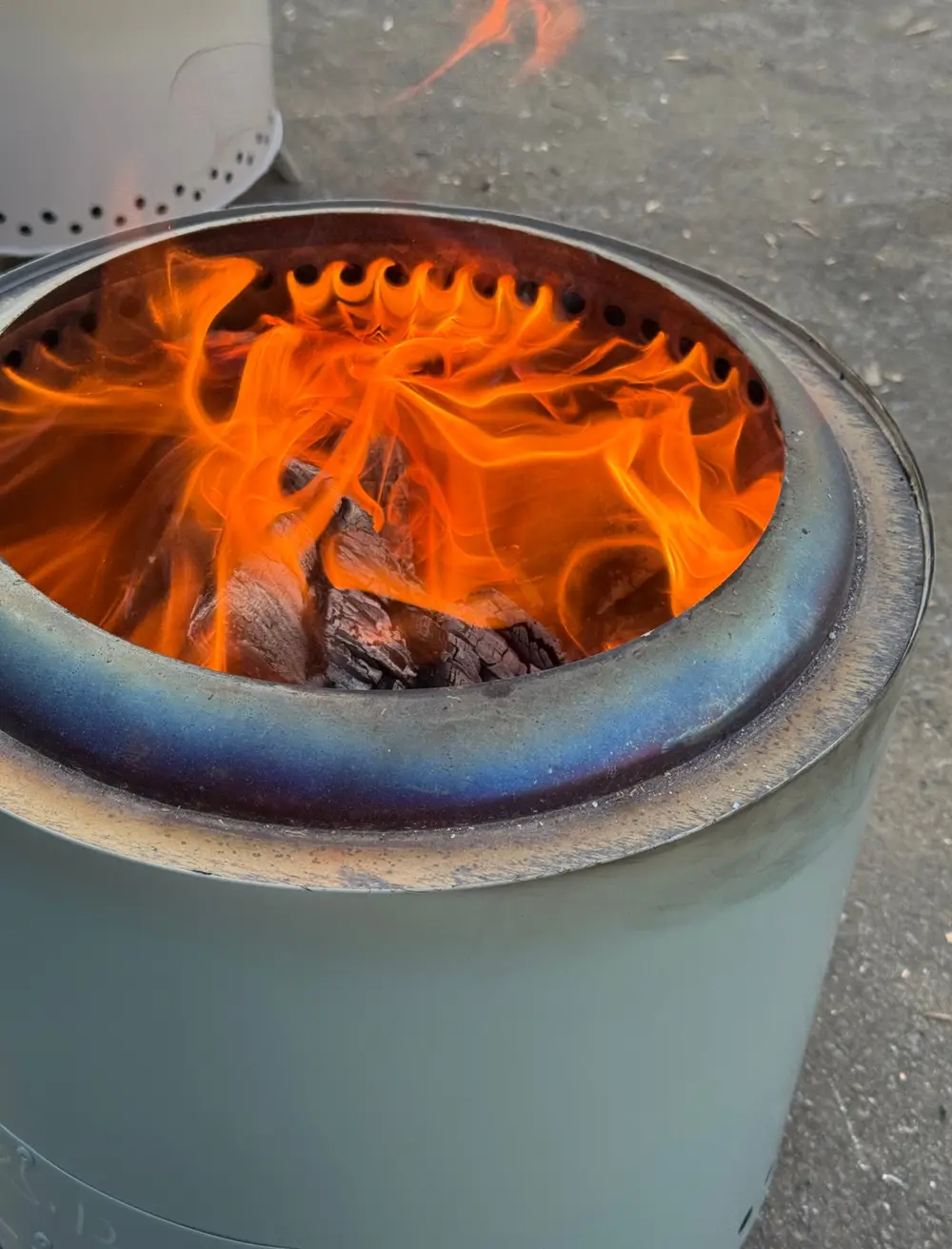
Understanding smokeless fire pit secondary combustion fail: a common misconception is that secondary combustion can be achieved through hole patterns or visual design alone.
In reality, secondary combustion requires a system:
- A defined secondary air chamber
- Controlled preheating of incoming air
- A stable airflow path separated from primary combustion
Many manufacturers rely on single-wall firebox designs, which structurally cannot support true secondary combustion.
Without an independent airflow layer and temperature buildup, secondary burn remains incomplete or inconsistent, regardless of appearance.
2. Air Intake Position Is Frequently Misjudged
Another recurring issue is improper air intake placement.
Some designs position intake holes primarily at the bottom of the fire pit, assuming this will naturally increase airflow.
In real outdoor use, bottom-positioned intakes often:
- Struggle to draw sufficient air once ash accumulates
- Become partially blocked during continuous burning
- Fail to maintain stable oxygen supply for secondary combustion
As a result, combustion efficiency declines over time rather than improving.
3. Visual Clean Burns Do Not Equal Functional Performance
Short-term clean flames can be misleading.
Without a properly structured secondary combustion system, smoke reduction is often temporary and dependent on ideal fuel and loading conditions.
Once variables change — fuel moisture, burn duration, ambient airflow — performance inconsistencies quickly surface.
4. Manufacturing Consistency Amplifies or Destroys Design Intent
Even well-designed systems fail if production consistency is ignored.
In secondary combustion fire pits, small dimensional deviations affect:
- Airflow velocity
- Combustion pressure balance
- Secondary flame stability
This is why units that appear identical can behave differently in the field.
What This Means for Trade Buyers
For distributors and brands, the risk is not adopting a new category — it is adopting an incomplete combustion concept.
Products built on simplified or visually driven designs often lead to:
- Inconsistent end-user experience
- Elevated after-sales involvement
- Difficulty defending performance claims
Understanding whether a fire pit is built as a combustion system, rather than a styled firebox, is critical for long-term commercial success.
Written by Ponel — Founder of OneProStove
Questions about the product or sourcing? Reach out directly — we respond within 1 business day:info@oneprostove.com
Looking to Source Smokeless Fire Pits Wholesale?
OneProStove supplies wholesale buyers across the US and Europe with SGS & EN certified fire pits and outdoor stoves. MOQ 10 units · OEM/ODM available · Ships from Ningbo · Reply within 24 hours.
For any smokeless fire pit use guide to be practical, it must address the two core variables: secondary combustion airflow design and ash management. OnePro Stove’s KZ-Series addresses both with patent-pending engineering.
Smokeless Fire Pit Use Guide — What B2B Buyers Should Check
This practical smokeless fire pit use guide section covers key technical specs. When evaluating a smokeless fire pit use guide for sourcing decisions, focus on three technical indicators: the secondary combustion hole diameter (should be 8–12mm for optimal airflow), the wall gap ratio between inner and outer cylinders (minimum 15mm), and the ash pan clearance from the base (should allow airflow underneath).
Smokeless Fire Pit Secondary Combustion Fail: The Physics Explained
Smokeless fire pit secondary combustion fail occurs when one or more of three physical conditions are not met: temperature threshold (secondary combustion requires sustained temperatures above 540°C at the secondary air injection point), airflow volume (insufficient secondary air flow — typically under 2.5 m/s velocity — means unburned gases escape before igniting), and injection geometry (holes positioned too high, too low, or at the wrong angle fail to create the turbulent mixing zone required for re-combustion).
Most commodity-grade smokeless fire pits fail on all three counts. The double-wall gap is too narrow (under 15mm) to generate adequate draft, the secondary holes are purely cosmetic in size, and there is no engineered restriction to build heat pressure. The result is visible smoke — regardless of what the product listing claims. For a deeper look at the structural weaknesses common across the industry, see most smokeless fire pit designs’ hidden problem.
When sourcing from Chinese manufacturers, ask specifically for the secondary air hole diameter, the inter-wall gap measurement, and the internal baffle configuration. These three data points will tell you more about real-world performance than any marketing claim. For a full supplier vetting checklist, see our B2B sourcing guide.
These specifications separate genuinely high-performance products from low-quality alternatives that produce smoke regardless of the fuel used.
OnePro Stove publishes detailed product specifications for all KZ-Series fire pits including airhole dimensions, wall thickness, and combustion efficiency ratings — making it easier for importers to compare and justify their purchasing decisions to end-buyers.
For more: KZ-S smokeless fire pit wholesale. Reference: ASTM International.
[…] This process burns off the fine particles that would have become smoke. Effective smokeless technology relies on this precise airflow management, not just a random pattern of holes. It’s a more […]