
By Ponel, Founder of OneProStove · Packaging & Quality · May 2026
If you have sourced smokeless fire pits before, there is a reasonable chance at least one shipment arrived with a dent on the outer wall. You may have assumed it was a logistics anomaly. It is not. It is a structural gap shared by every fire pit supplier in the category — and one that the industry has never formally addressed.
This article explains why transit dents happen, why the current industry-standard packaging fails to prevent them, and what OneProStove is doing differently.
Why smokeless fire pits dent during shipping
The stainless steel outer wall of a smokeless fire pit is typically 0.8 to 1.2 mm thick — strong enough for regular outdoor use, but not designed to resist concentrated point-load impacts with no cushioning between it and a corrugated carton wall.
A cylindrical body has no flat load-bearing face. When a carton is knocked sideways — which happens at every handling point across a standard China-to-destination shipment — all force concentrates at whatever point first contacts the inner box wall. With nothing to distribute that force, the result is a dent. Every time. On every brand.
The packaging gap every fire pit wholesaler should know
The current industry standard — used by virtually every fire pit supplier including market leader Solo Stove — is a 5-ply corrugated carton with rigid EPS foam end caps on the top and bottom. This configuration protects the product axially: it handles stacking pressure and vertical drops.
What it does not protect is the cylindrical outer wall against lateral impact. The EPS end caps hold the product in place vertically, but leave the sides of the stainless steel cylinder in direct contact range with the inner carton wall. There is no cushioning layer. There is no buffer.
The public evidence is substantial:
“Nearly all the negative reviews were about dents presumably made during transit.”
— Ideal Home, independent product review of Solo Stove Bonfire 2.0 on Amazon
“I have received a couple of dented products now… Solo Stove may want to consider adding more packing materials.”
— Family Handyman, professional product tester (noted across two separate product reviews)
Solo Stove even maintained a dedicated customer support page titled “My fire pit arrived dented/damaged” — a clear indicator that the problem reached a scale requiring its own service workflow. The complaint has been documented in buyer forums as far back as 2017. The packaging has not changed.
For wholesale buyers and brand partners sourcing stainless steel fire pits from China, this is not a minor logistics footnote. It is a customer service cost, a review problem, and a reorder risk — compounded across every shipment.
How OneProStove solved transit dent for wholesale buyers
OneProStove is rolling out a full-body high-density EPE foam sleeve as the new standard packaging configuration across our product line. Unlike the rigid EPS foam used as end caps in the current industry standard, EPE (expanded polyethylene) is a flexible, resilient material that compresses on impact and returns to its original form. It does not crack, crumble, or transfer force to the product surface.
The EPE sleeve completely encloses the fire pit cylinder — top, sides, and bottom — before the product enters the 5-ply corrugated carton. This creates a uniform 360-degree buffer layer between the stainless steel outer wall and the carton at every point. A lateral knock no longer reaches the product surface.
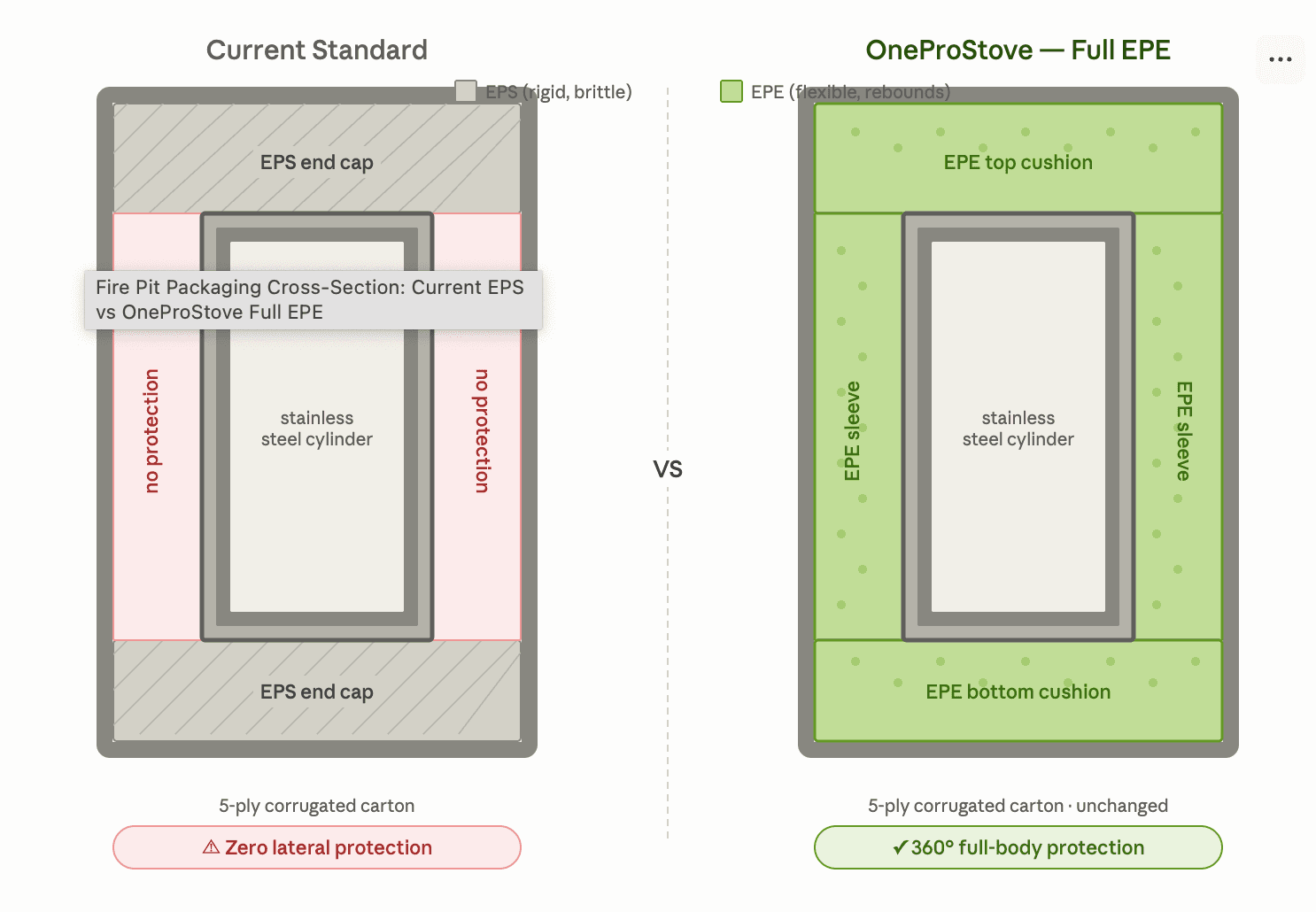
The outer 5-ply corrugated carton is retained. The change is one additional layer — and it addresses the one structural gap the existing configuration could not cover.
Sourcing smokeless fire pits from China: what to ask about packaging
If you are evaluating fire pit suppliers for wholesale purchasing, OEM manufacturing, or branded product development, packaging specification is a supplier qualification question — not an afterthought. The questions that matter:
- What material protects the cylinder outer wall during transit?
- Is there any lateral cushioning between the product and the carton?
- What is the documented transit damage rate on past shipments?
- Can you provide a packaging specification sheet?
Most smokeless fire pit manufacturers — including well-known names — will not have a clear answer to the first two questions. That gap is precisely what this packaging upgrade addresses.
OneProStove supplies smokeless fire pits, wood stoves, and outdoor heating products to wholesale buyers and OEM partners across North America and Europe. Packaging documentation and product samples are available on request.
Interested in wholesale or OEM sourcing?
We supply smokeless fire pits and outdoor stoves to retailers, outdoor brands, and brand partners. MOQ, lead times, and packaging specs available on request.
Contact OneProStove
FAQ
Why do smokeless fire pits arrive dented?
Most fire pits ship with EPS end caps that protect the top and bottom, but provide no lateral protection for the cylindrical outer wall. When the carton receives a sideways impact during transit, force concentrates on one point of thin stainless steel with nothing between it and the box wall — causing a dent.
Does OneProStove offer wholesale and OEM fire pit sourcing?
Yes. OneProStove supplies smokeless fire pits and outdoor stoves to retailers, outdoor brands, and OEM partners across North America and Europe. Contact us for MOQ, pricing, and lead time information.
What packaging does OneProStove use for fire pit shipments?
We are rolling out a full-body high-density EPE foam sleeve that encloses the entire cylinder — top, sides, and bottom — inside a 5-ply corrugated outer carton. EPE absorbs lateral impact and rebounds, providing 360-degree protection that the previous EPS end cap configuration could not offer.
What is the difference between EPS and EPE foam in packaging?
EPS (expanded polystyrene) is rigid and brittle — it provides good compressive strength for stacking but cracks under lateral impact. EPE (expanded polyethylene) is flexible and resilient — it compresses on impact and returns to shape, making it the correct material for protecting curved metal surfaces during transit.
Founder of OneProStove, an OEM/ODM manufacturer of smokeless fire pits and outdoor stoves based in China. Supplying wholesale buyers and brand partners across North America and Europe.
Questions about the product or sourcing? Reach out directly — we respond within 1 business day:info@oneprostove.com