
A double wall fire pit works through a three-part engineering system: an inner combustion wall, an outer structural wall, and a functional air gap with secondary combustion vents. When all three components are correctly designed and proportioned, preheated air re-enters the flame zone to burn unburned gases before they escape as smoke. When any component fails, the product carries the label but not the performance.
This guide is part of our complete smokeless fire pit sourcing guide, covering structure, materials, coatings, packaging and market data.
What you will learn in this article:
- What the three components of a true double wall fire pit are and how they work together
- How the three-stage secondary combustion process operates from air intake to flame injection
- Why outer wall temperature, combustion efficiency, and material longevity all depend on correct double wall engineering
- What distinguishes a structurally compliant double wall product from one that genuinely performs
- First-hand manufacturing observations from OneProStove’s production and validation experience
- How to read a double wall fire pit’s design against these engineering principles
What Is Double Wall Fire Pit Design?
The term “double wall fire pit” appears on product listings across every major retail channel in the United States. It is used to signal smokeless performance, safety, and build quality. But the engineering behind it is rarely explained — and the gap between the label and the reality is wider than most buyers realise.
A true double wall fire pit is defined by three structural components working together. The inner combustion wall contains the fire and transfers heat outward into the air gap. The outer structural wall provides the physical form of the product and encloses the air channel. Between them sits the functional air gap combined with secondary combustion vents at the top of the gap. These two middle elements — the gap and the vents — are what make the system work. Without them, a product with two steel layers is not a double wall fire pit in any meaningful engineering sense.
Remove the functional air gap and you have a product with two walls and no airflow channel. Position the top vents incorrectly and preheated air never reaches the flame zone. Either failure produces a product that is cosmetically double wall but thermally behaves like a single wall fire pit. The outer wall runs hotter than expected. Smoke continues to build. The secondary flame ring that characterises a functioning system never appears.
Two steel layers welded together do not constitute a double wall fire pit. This distinction is invisible from the outside and absent from most product descriptions. It is the reason two products carrying identical labels can deliver completely different combustion results.
Factory Observation: What Two Steel Walls Failed to Do
In the fire pit industry, double wall construction and smokeless performance are frequently treated as synonymous. We disassembled a double wall smokeless fire pit sourced from the market to understand why a sample was underperforming. From the outside, the product had everything buyers expect: a double wall structure, top rim vents, and base air intakes. During testing, the flame burned normally. Smoke continued to build. The outer wall temperature ran significantly higher than expected.
Further disassembly revealed the issue was not material quality. It was air system design. The air channel between the inner and outer walls was too narrow for air to gain sufficient preheat as it rose. The top vents existed but were not effectively connected to the preheated air path — they were drawing in ambient air rather than delivering preheated air into the combustion zone.
The result: unburned gases released by the wood exited the chamber as visible smoke rather than undergoing secondary combustion at the top. Two steel layers, no secondary combustion.
This is the most commonly overlooked problem in the category. The complete system — inner wall, outer wall, air channel, and top injection vents — must function as a unit. Any single element failing produces a product that is structurally double wall and thermally performs like a single wall fire pit.
The Physics: How the Three-Stage Combustion System Works
How does a smokeless fire pit work at the engineering level? The answer is a sequential three-stage process. Each stage depends on the one before it, which is why a failure at any point breaks the entire system.
Step 1: Primary combustion and wall heating
Wood ignites in the inner chamber. Combustion gases and heat radiate outward through the inner wall into the air gap. Simultaneously, cold ambient air enters the base of the gap through intake vents positioned low on the outer wall. This first stage is identical to combustion in any wood-burning fire pit. The double wall system’s contribution does not begin here — it begins in Stage 2.
Step 2: Air preheating in the gap
As cold air enters the base of the gap and rises alongside the heated inner wall, its temperature increases steadily. Density drops as the air warms, creating a stable upward chimney-effect current that draws fresh air in from below continuously without mechanical assistance. This is the stage that fire pit combustion explained in most articles skips entirely. The gap is noted as existing; its engineering role in the preheating process is not addressed.
Gap width is not arbitrary. It is engineered relative to the product’s diameter, wall height, and number of intake vents. OneProStove full-size fire pits use approximately 20mm, matched to a larger combustion chamber volume and corresponding airflow requirement. Compact tabletop models such as the KZ-X220 use 5–8mm, correctly proportioned for their compact chamber geometry, and deliver equivalent smokeless performance. There is no universal minimum figure that applies across all products. What matters is whether the gap is correctly proportioned for the system it serves.
Step 3: Secondary combustion injection
Preheated air exits through injection vents at the top of the air gap as a pressurised jet directed inward into the flame zone. High-temperature oxygen meets the rising column of unburned gas particles and reignites them before they can exit the chamber. The visible result is a continuous secondary flame ring along the upper rim — the signature of a correctly functioning double wall fire pit.
According to the U.S. EPA, when wood is not burned completely, the resulting smoke contains PM2.5 fine particles along with benzene, formaldehyde, acrolein, and polycyclic aromatic hydrocarbons. Secondary combustion directly addresses this by reigniting unburned gases before they exit the chamber. The more efficiently wood burns, the less smoke is created — this is the engineering principle the entire double wall system is built around. The same construction is sometimes marketed as a double burn fire pit; the mechanism is identical — two combustion events instead of one. Why some double wall products still smoke in real use is covered in our secondary combustion analysis.

Why It Matters: Safety, Efficiency, and Longevity Compared
Understanding how the system works establishes why correct double wall engineering matters across three dimensions: the safety of the people using the product, the combustion quality they experience during use, and how long the product performs as intended.
Safety — Outer Wall Temperature and What It Means
A single wall fire pit transfers combustion heat directly to its outer surface. Under a full fire load, that outer surface reaches temperatures high enough to cause immediate burns on contact. A correctly engineered double wall fire pit keeps the outer surface significantly cooler because the air gap acts as a thermal buffer between the combustion chamber and the exterior wall.
It is worth stating honestly: Solo Stove’s own press materials acknowledge that outer walls “become extremely hot” even on their double wall designs, which is why they introduced the Surround protective barrier accessory. The insulating effect of a double wall air gap reduces outer wall heat — it does not eliminate it. The degree of reduction depends on gap width, wall thickness, and the overall system design. This is precisely why understanding the engineering matters: “double wall” on a product label does not specify how much thermal buffering the design actually provides.
Combustion Efficiency — Why a Hotter Fire Is a Cleaner Fire
Incomplete combustion is the direct source of visible smoke. When wood burns without sufficient oxygen reaching the flame at the right temperature, unburned carbon particles and gases escape as smoke rather than completing the combustion cycle. Secondary combustion intercepts this process by injecting preheated oxygen directly into the rising column of unburned material at the point of highest concentration.
The U.S. Department of Energy notes that higher-efficiency wood-burning appliances produce lower emissions because more complete combustion leaves fewer unburned byproducts. Double wall design applies this same principle to outdoor fire pits. The practical outcome is less ash per session, a cleaner and more stable flame, and longer burn time per load. The fire consumes fuel more fully rather than venting it as visible smoke.
Structural Longevity — Two Walls Under Different Conditions
The inner and outer walls of a double wall fire pit face entirely different operating conditions and require different material specifications accordingly. The inner wall experiences direct thermal cycling — temperatures up to 600°C repeatedly across hundreds of burn sessions. 304 stainless steel is the minimum appropriate grade for this application. Lower grades degrade structurally under sustained thermal stress and begin showing visible deterioration within two to three years of regular use.
The outer wall faces oxidation, moisture exposure, and physical impact rather than direct heat. Material grade at the outer wall determines long-term finish quality and corrosion resistance. Mixed-grade construction — 304 SS inner wall paired with a lower-grade 201 SS outer wall — reduces durability without any visible difference at the time of purchase and only becomes apparent after one to two seasons of outdoor exposure.
Double wall design is an engineering foundation, not a quality guarantee in itself. Gap width, vent position, and material grade all determine whether the system performs as described above. The following section examines what correct implementation looks like in practice.
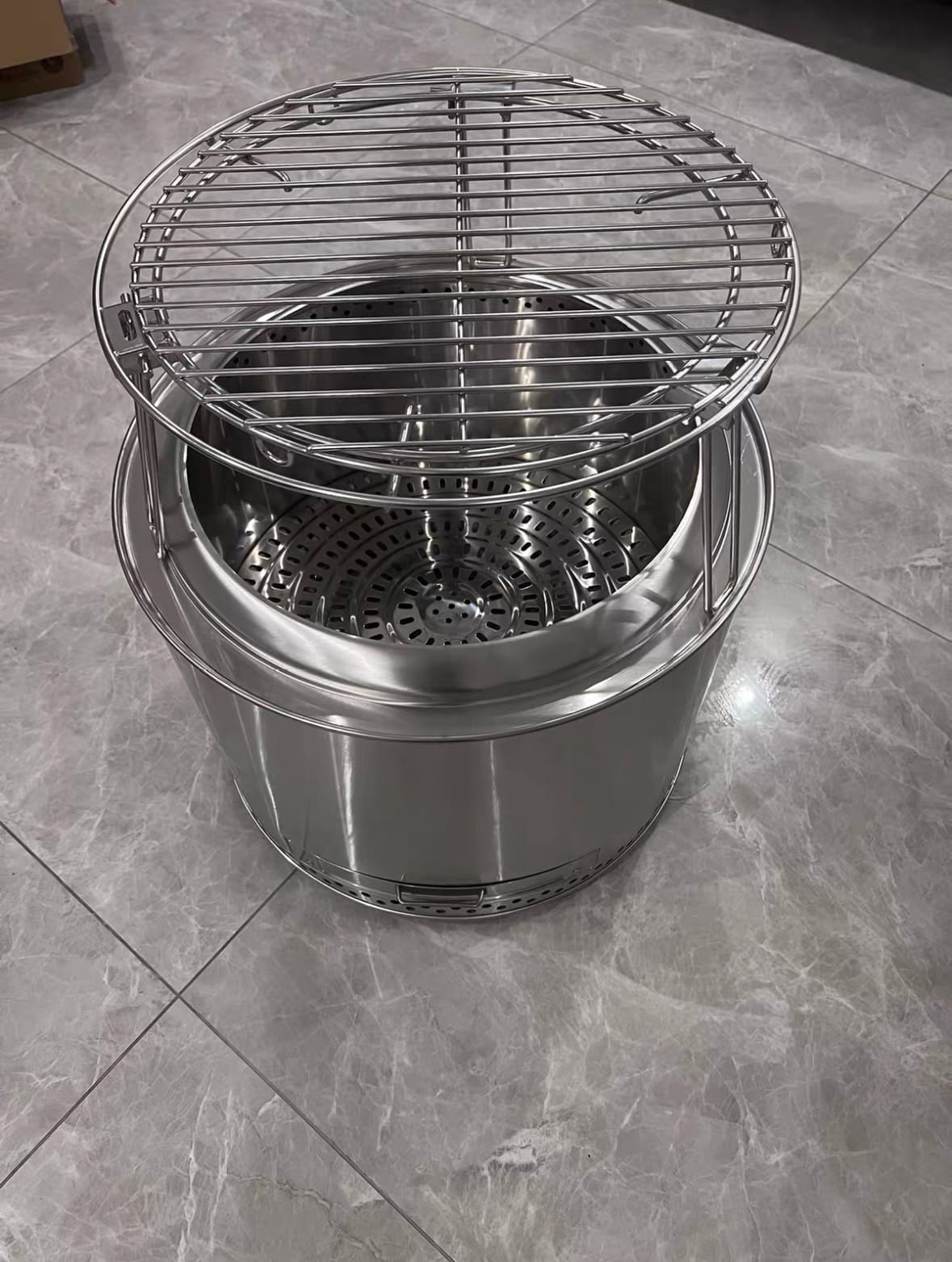
Single Wall vs. Double Wall: Full Engineering Comparison
The performance differences between single and double wall construction extend across every aspect of how a fire pit operates. The table below summarises the key distinctions based on OneProStove manufacturing observation.
| Feature | Single Wall | Double Wall |
|---|---|---|
| Outer wall temp (full load) | High — direct heat transfer from combustion | Lower — air gap provides thermal buffer |
| Secondary combustion | ✗ Not structurally possible | ✓ Enabled when correctly engineered |
| Visible smoke reduction | Limited | Significant under dry fuel conditions |
| Wood utilisation | Lower — unburned gases exit as smoke | Higher — secondary combustion burns unburned gases |
| Outer wall contact risk | Higher | Lower |
| Material cost premium | Baseline | Approximately +15–25% |
| Expected product lifespan | 2–4 years with regular outdoor use | 4–8 years with correct material specification |
| US mainstream retail channel access | Limited | Mainstream |
Data based on OneProStove manufacturing observation. Individual product performance varies by design quality and material specification.
Two important clarifications apply to this comparison. First, a double wall product that fails on gap width or vent position will perform closer to the single wall column than the double wall column in this table — the label does not determine the performance outcome, the engineering does. Second, the lifespan figures assume outdoor use in a temperate climate with appropriate cover when not in use; coastal or high-humidity environments will accelerate degradation regardless of wall construction type.
What Separates a Real Double Wall from One That Only Looks Like It
How the term appears in product listings and how the design performs at the factory level are two different things. Three engineering variables determine whether a double wall product functions as designed or carries the label without the performance.
The Air Gap — Proportion Determines Function
Air gap width is not defined by a universal minimum. It is engineered relative to the product’s diameter, wall height, and number and size of intake vents. A gap correctly proportioned for a 24-inch full-size fire pit would be structurally incorrect for a compact tabletop model of 12-inch diameter.
OneProStove full-size fire pits use approximately 20mm, matched to larger combustion chamber volume and the corresponding airflow volume required to sustain secondary combustion. The KZ-X220 tabletop model uses 5–8mm, proportioned to its compact chamber geometry, and achieves equivalent smokeless performance. The variable that determines function is not the absolute gap measurement — it is whether the gap is correctly sized relative to the system it operates within. A gap clearly too narrow for the product’s diameter restricts airflow and reduces the preheating time available before air reaches the injection vents. An absent gap eliminates secondary combustion entirely regardless of what the outer wall design suggests.
Injection Vent Position — The Detail That Determines Whether Secondary Combustion Fires
Injection vents must be positioned at the top of the air gap, with their exit directed inward into the combustion chamber. This specific geometry is what delivers preheated air as a pressurised jet at the point where unburned gases are most concentrated — at the top of the rising flame column.
Vents positioned on the outer wall surface rather than at the gap exit function only as primary air intake. They draw cold ambient air into the base of the gap but cannot deliver preheated air into the flame zone. A product can have visible holes at its rim, look identical to a correctly designed product, and still fail to produce secondary combustion if those holes exit through the outer wall rather than the air gap. This is the hidden structural problem in most smokeless fire pit designs — one that is undetectable from photographs, specification sheets, or visual inspection of the finished product.
Project Case: When a Smokeless Fire Pit Wasn’t Truly Smokeless
During the sample validation stage of a North American market project, the team conducted continuous burn testing on a sample that met double wall construction requirements. Appearance and manufacturing quality reached the expected standard. Once combustion entered a stable phase, however, visible smoke began appearing at the top of the product.
For a standard fire pit, this would not be unusual. For a product positioned as smokeless, it indicated that the secondary combustion system was not functioning. The team examined the airflow path. Preheated air was reaching the top area through the gap, but the injection vent direction was misaligned. Air was entering the chamber but not being directed into the core flame zone. Oxygen was present. Heat was present. They were not meeting at the correct location.
The team adjusted the layout and deflection angle of the top injection vents and refined the airflow path geometry. On retesting, a continuous, stable secondary flame ring formed along the upper rim. The previously visible smoke plume was reignited and consumed. Residual charcoal and ash after burning were noticeably reduced.
The project confirmed the operating principle: buyers judge the result by the flame, while secondary combustion is decided by the airflow path — how air is drawn in, preheated, and returned to the flame zone at the correct angle to complete the second combustion event.
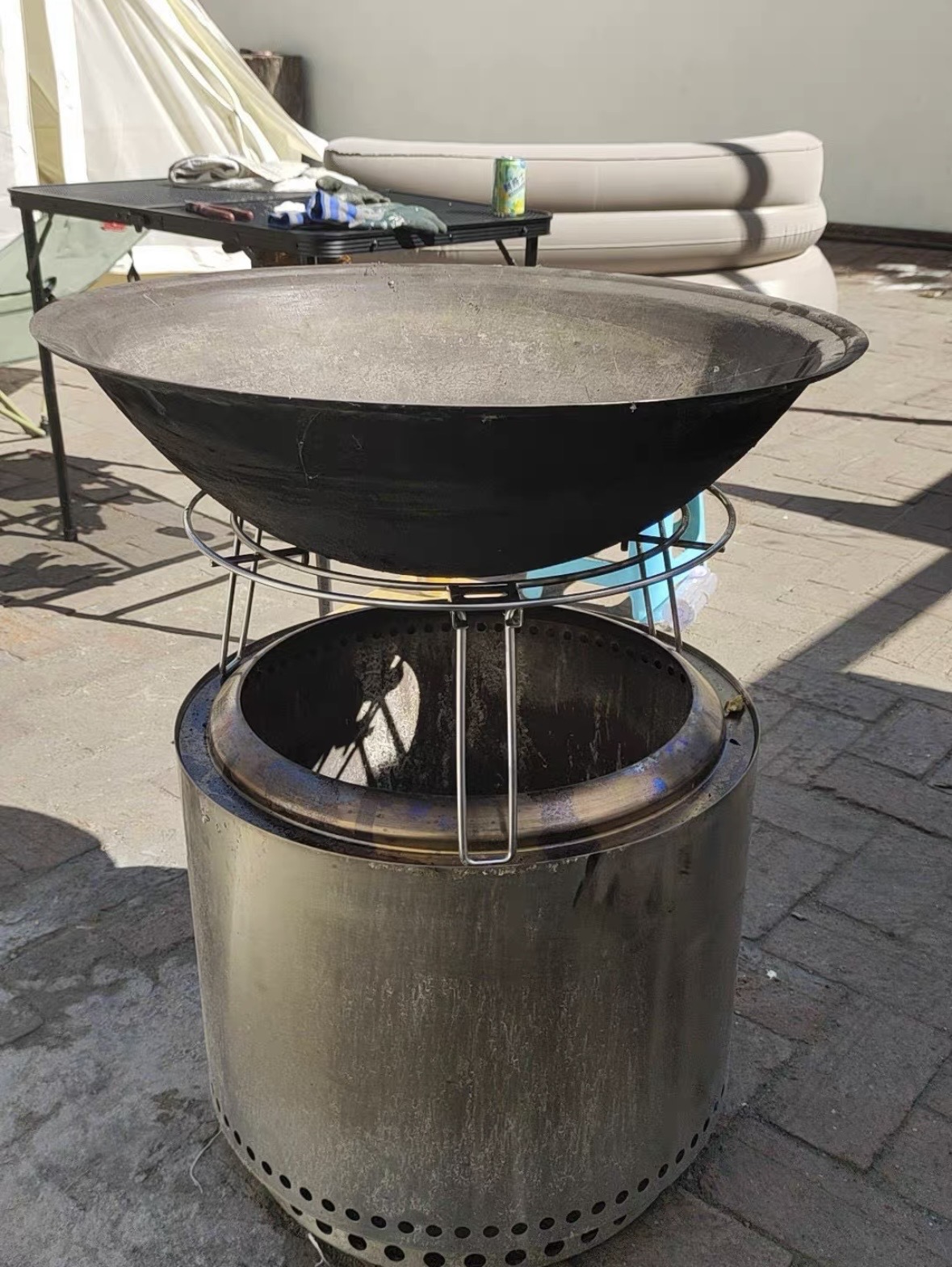
Wall Material Consistency — Two Walls, Two Different Requirements
The inner wall requires 304 SS as a minimum for structural integrity under sustained thermal cycling. The outer wall requires a material grade that resists oxidation and moisture across outdoor seasonal exposure. These are distinct requirements and do not always receive the same specification in cost-reduced manufacturing.
Mixed-grade construction — 304 SS inner wall with 201 SS outer wall — is a cost reduction measure that is invisible at point of purchase. The difference only becomes apparent after one to two seasons of outdoor use, when the outer wall shows surface degradation while the inner wall remains structurally sound. A thorough understanding of 304 vs. 201 stainless steel is the necessary context for evaluating any double wall fire pit’s real-world longevity.
Surface Treatment — Engineering, Not Aesthetics
High-temperature paint, ceramic coating, and powder coat behave differently above 200°C. The outer wall of a double wall fire pit reaches elevated temperatures during use — not at combustion chamber levels, but high enough that standard consumer-grade coatings fail prematurely when incorrectly specified. Surface treatment strategies for smokeless fire pits are an engineering decision that determines long-term corrosion resistance and appearance, not a cosmetic choice made after the structural design is finalised.

FAQ
Q1: What is the air gap in a double wall fire pit?
The air gap is the channel between the inner and outer walls. It has two engineering functions: preheating intake air as it rises toward the injection vents, and providing a thermal buffer that reduces outer wall temperature relative to the inner combustion wall. Correct gap width depends on the product’s diameter, wall height, and vent configuration. OneProStove full-size fire pits use approximately 20mm; compact tabletop models such as the KZ-X220 use 5–8mm with equivalent smokeless performance. No universal minimum applies across all product sizes.
Q2: Does double wall design make a fire pit smokeless?
Double wall construction enables secondary combustion — the process that burns unburned gas particles before they exit as visible smoke. It is a necessary structural condition for smokeless performance, not a sufficient one. Correct gap proportion, correct injection vent position, and dry seasoned fuel are all required for secondary combustion to activate consistently. A double wall product with a misaligned vent or undersized gap will produce smoke regardless of what the label states.
Q3: How does a smokeless fire pit work differently from a traditional fire pit?
A traditional fire pit relies on ambient airflow and produces a single combustion event. Unburned gases from that event exit as smoke. A double wall fire pit channels intake air through an internal gap, preheats it using the thermal energy of the fire itself, and injects it back into the flame zone as a pressurised jet. This second combustion event burns the gases that would otherwise become visible smoke. The result is a hotter, cleaner flame with significantly less smoke output under correct operating conditions.
Q4: What steel grade should a double wall fire pit use?
304 stainless steel is the appropriate specification for both walls in a quality-grade double wall fire pit. The inner wall undergoes repeated thermal cycling up to 600°C; 201 SS has significantly lower thermal and corrosion resistance and degrades structurally faster under these conditions. The outer wall faces moisture and oxidation; 201 SS outer walls show surface degradation within one to two outdoor seasons in humid or coastal environments where 304 SS outer walls remain stable.
Q5: Why do two products both labelled “double wall” perform so differently?
The label identifies a construction type, not a performance standard. Three factory-level variables determine whether a double wall product delivers secondary combustion in practice. Injection vent position: vents exiting the outer wall surface provide primary intake only and cannot deliver preheated air to the flame zone. Gap proportion: a gap too narrow for the product’s diameter restricts preheated airflow regardless of what the specification states. Material consistency: mixed-grade construction pairs a functional inner wall with a lower-grade outer wall that degrades faster without any visible difference at purchase. Two products identical in appearance can deliver completely different combustion results because of these three variables.
Q6: How do I know if a double wall fire pit is correctly engineered?
A correctly functioning double wall fire pit produces a visible secondary flame ring along the upper rim once the fire reaches operating temperature — typically 10 to 15 minutes into a burn with dry hardwood. If smoke continues building after the fire is established and no secondary flame ring appears, the secondary combustion system is not activating. This indicates a problem with gap proportion, vent position, or both — regardless of how the product is described. The evidence standards in our fire pit supplier verification checklist apply directly here.
About the Author
Ponel is the founder of OneProStove, based in Ningbo — China’s primary manufacturing hub for stainless steel outdoor fire pits. Ponel works directly with production lines and quality control teams across product development, sample validation, and pre-shipment inspection cycles. The manufacturing observations, product data, and project cases cited in this article are drawn from direct factory experience supplying B2B buyers in the US, Australia, and Europe.
OneProStove products are manufactured under ISO 9001 quality management standards. All stainless steel specifications are verified against mill test certificates at incoming material inspection. Third-party pre-shipment inspection via SGS, Bureau Veritas, or QIMA is supported for all wholesale orders.
For technical questions about double wall fire pit specifications or sourcing enquiries, contact the OneProStove team directly.
Learn more about OneProStove → · Contact us →
Explore our smokeless fire pit range →
Next Step: Source from OneProStove
To see this structure on a current production model, see the KZ-X220 tabletop smokeless fire pit — the compact model referenced above — or explore our wholesale program: MOQ 10 units per model, 7-day sampling, 15–45 day lead time, OEM/ODM support. Questions? Contact us.
Related reading: Demystifying Smokeless Fire Pits · Fire Pit MOQ: How Small Orders Get Accepted · Fire Pit Supplier Verification · Smokeless Fire Pit ODM at Low MOQ
[…] The manufacturing point worth stating clearly: the engineering principle behind secondary combustion is not Solo Stove’s intellectual property. Double wall secondary combustion design is a manufacturing methodology available to any supplier executing it correctly. The distinction between suppliers who execute it correctly and those who carry the label without the performance is where the wholesale buyer’s due diligence actually lives. For a detailed technical breakdown of how double wall construction works and how to distinguish real performance from visual imitation, see our our double-wall design guide. […]
[…] smokeless effect is produced by structure, not coating: a double-wall body heats air in the gap between its walls, and the preheated air reignites smoke gases at the upper […]
[…] Double Wall Fire Pit Design Explained — The double-wall mechanism behind secondary burn, explained step by step. […]
[…] list is in our fire pit supplier verification checklist, the structural background is in our double wall design guide, and the material comparison is in 304 vs 201 stainless […]