

Most buyers searching for solo stove alternatives wholesale are not looking for a cheaper version of the same product. They are looking for a supplier who can help them build a profitable, differentiated position in a market that Solo Stove has already spent years validating. The right question is not “which product is cheapest” but “which supplier gives me the tools to compete on something other than price.”
What this guide covers:
- Why the smokeless fire pit market represents a genuine wholesale opportunity in 2026
- What Solo Stove’s price actually pays for, and what that leaves open for competitors
- The 5 supplier evaluation criteria that consumer reviews never address
- How to compare the three main wholesale sourcing channels by margin structure, not just product
- A 5-step protocol for verifying double-wall construction quality before bulk commitment
- A retail price model to calculate your landed cost ceiling before your first inquiry
Why the Smokeless Fire Pit Market Is Worth Entering Right Now
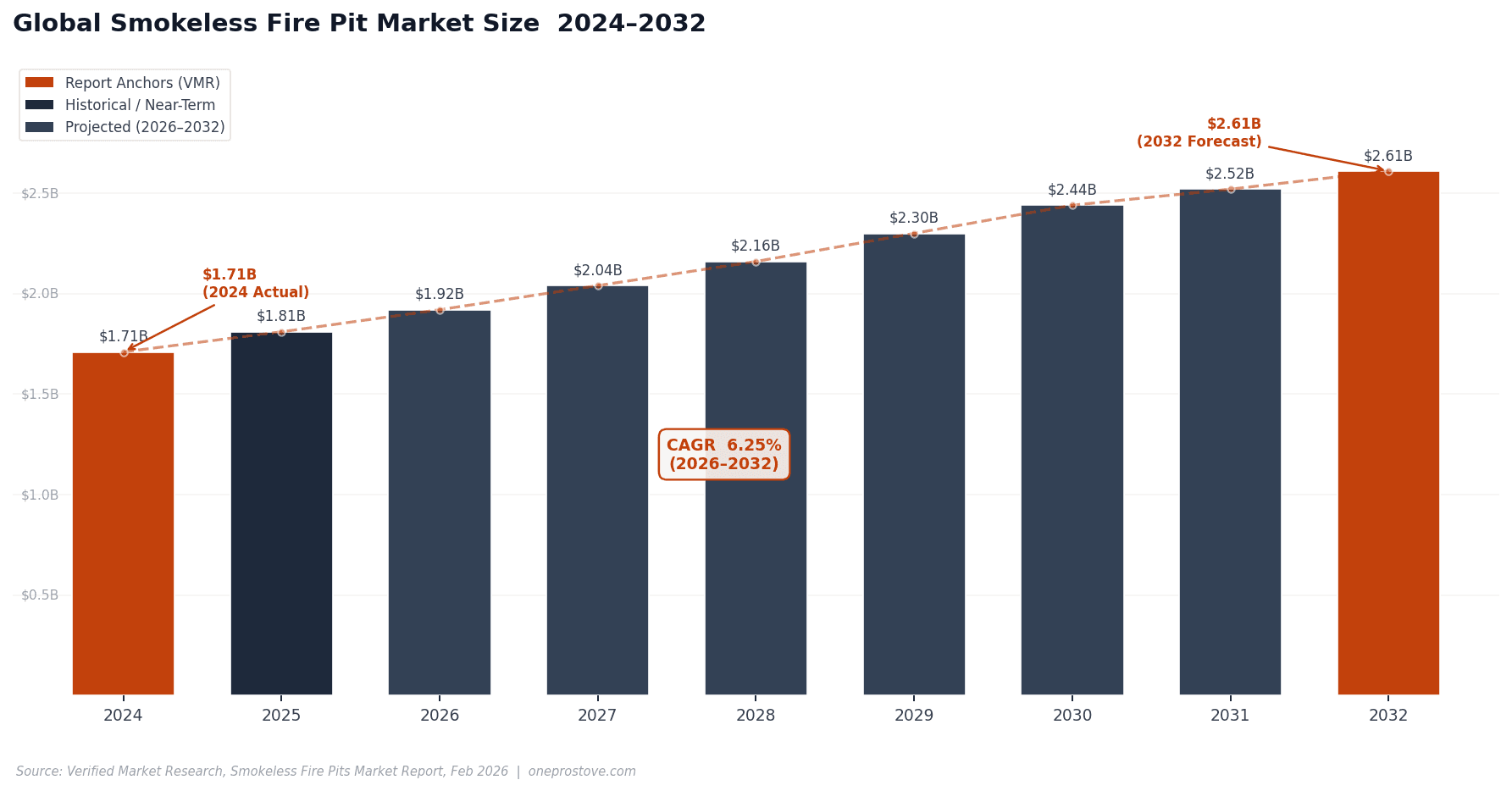
According to a February 2026 report by Verified Market Research, the global smokeless fire pit market was valued at $1.71 billion in 2024 and is projected to reach $2.61 billion by 2032, growing at a CAGR of 6.25%. North America remains the primary revenue contributor, driven by established backyard culture and strong demand for outdoor living products. Wood-burning smokeless models account for approximately 66.55% of total segment revenue in 2024.
Those numbers describe scale. What they do not capture is the structural change Solo Stove triggered in this category. Before Solo Stove reached mainstream retail, smokeless fire pits were a niche product with limited consumer awareness. After it, they became an expectation. Solo stove competitors entering the market today do not need to educate buyers about why smokeless performance matters. That work is done. Consumers already understand the value proposition; many have already purchased at the $249 to $330 price point and are ready to replace, upgrade, or gift.
For a wholesale buyer, this is the relevant signal: you are entering a market with trained demand, established price acceptance, and growing category visibility in retail, e-commerce, and corporate gifting channels. The question is not whether the market exists. The question is which supplier gives you the tools to hold a position within it.
For detailed category data and market trend analysis, see our smokeless fire pit market overview.
What Solo Stove Gets Right: What the Price Tag Actually Covers
Every conversation about solo stove competitors begins in the same place: Solo Stove’s product is genuinely good. Understanding exactly why matters more than dismissing the premium.
The Engineering That Justifies the Premium: Secondary Combustion and Double Wall Design
A Solo Stove fire pit works through a three-part airflow system. Cold air enters through intake vents at the base. It travels upward through the channel between the inner combustion wall and the outer structural wall, gaining heat as it rises. At the rim, preheated air exits through secondary burn holes directed inward into the flame zone, reigniting unburned combustion gases before they can escape as smoke. When correctly engineered, the result is a continuous secondary flame ring along the upper rim and a significantly cleaner burn than a single-wall fire pit produces.
The 304 stainless steel construction is not a marketing specification. Under repeated thermal cycling at outdoor fire temperatures, lower-grade alternatives, 201 stainless steel in particular, show accelerated surface degradation and structural weakening over two to three seasons of regular use. 304 steel maintains corrosion resistance and structural integrity across that exposure window. According to the U.S. EPA, incomplete wood combustion produces PM2.5 fine particles alongside benzene, formaldehyde, and polycyclic aromatic hydrocarbons. Secondary combustion directly addresses this by burning those gases inside the chamber rather than releasing them as visible smoke.
The manufacturing point worth stating clearly: the engineering principle behind secondary combustion is not Solo Stove’s intellectual property. Double wall secondary combustion design is a manufacturing methodology available to any supplier executing it correctly. The distinction between suppliers who execute it correctly and those who carry the label without the performance is where the wholesale buyer’s due diligence actually lives. For a detailed technical breakdown of how double wall construction works and how to distinguish real performance from visual imitation, see our our double-wall design guide.

What the $249–$330 Retail Price Actually Buys
Solo Stove Bonfire’s current Amazon price is $249.99. The official MSRP is $329.99. Home Depot lists it at $329.99. (All prices recorded March 2026 from public retail listings.)
That range includes three cost layers:
- Engineering and materials: 304 stainless steel, precision airflow geometry, thermal-rated construction
- Certification and compliance: testing, quality documentation, product liability infrastructure
- Brand premium: marketing investment, community development, retail channel relationships, and the consumer recognition that now preloads purchase trust before a buyer sees any competing product
The third layer is significant. It is also the layer that creates your entry point. The brand premium Solo Stove commands is not transferable to a competing product. What is transferable is the consumer confidence that premium built, at the price point that confidence established. That is the market you are entering.
The 5 Questions Wholesale Buyers Must Ask (That Consumer Reviews Never Cover)
Consumer reviews evaluate solo stove alternatives wholesale candidates on smoke performance, portability, and retail price. These are valid product questions. They are not supplier questions. A wholesale buyer needs answers to a different set of questions before product evaluation becomes meaningful.
1. Does the Supplier Support OEM and Custom Branding?
Custom branding is the structural mechanism that removes your product from direct price comparison. A product carrying your logo, in a colorway exclusive to your channel, in packaging that carries your brand narrative, cannot be found in an Amazon search result sorted by price alongside an identical product from a competing source. That is not a marginal improvement in market position. It is the foundational answer to commodity distribution.
The relevant distinction is between OEM support, applying your brand to an existing product, and ODM capability, modifying the product’s configuration, design, or aesthetic for your specific market. A supplier with only OEM capability sets a ceiling on product differentiation. A supplier with ODM capability extends that ceiling. As a fire pit OEM manufacturer, the question to ask is not “can you add my logo” but “can you change the colorway, adjust the configuration, and produce something visually distinct from everything else in your standard catalog.”
2. What Certifications Cover Your Target Market?
The US market currently has no mandatory certification requirement for consumer-grade wood-burning fire pits. This means certification is a competitive advantage rather than a regulatory floor. An EN 1860 test report or SGS inspection certificate strengthens your negotiating position with large retail buyers and provides a documented quality basis for consumer-facing claims.
The EU market has a defined entry requirement: CE certification combined with EN 1860-1:2024 compliance. If your channel strategy includes European distribution at any point, certification documentation is a non-negotiable line item in your supply agreement, negotiated before the first sample is ordered, not requested after production is already complete.
3. What Is the Real MOQ and How Flexible Is the Lead Time?
Most smokeless fire pit suppliers set minimum order quantities between 50 and 200 units. That threshold is often where the quoted figure ends and the operational reality begins. Factory-direct suppliers at the lower end of that MOQ range frequently deliver inconsistent quality control, variable lead times, and limited accountability when problems arise. The minimum order is low; the risk structure is not.
The more useful evaluation tool is how a supplier handles a small initial sample order. Processing speed, communication quality, and product consistency on a 10 to 20-unit validation order reveal more about a supplier’s operational reliability than any factory audit document. Suppliers who treat small orders as a genuine commitment signal, rather than a preliminary to the order that actually matters to them, are the ones worth scaling with.
4. Who Is Accountable When Quality Fails?
Factory-direct purchasing, open market sourcing, and working with a specialized sourcing partner are not simply different price points. They produce different accountability structures when something goes wrong.
When a quality failure occurs in a factory-direct relationship, the buyer’s recourse is a negotiation with the same party that caused the problem. When it occurs through a sourcing partner with its own quality system, the partner’s process failed and the partner owns the resolution. The verifiable indicators of that accountability are: documented third-party pre-shipment inspection reports, written quality terms in the supply agreement, and evidence that the supplier has internal capacity to investigate failures rather than redirect them.
5. Does Your Margin Model Work Before You Place the Order?
The most persistent sourcing error in this category is beginning with a supplier’s quoted price and working forward to determine whether the business is viable. The correct sequence reverses that: establish your retail price target, determine the required margin, calculate the maximum landed cost, and then evaluate supplier quotes against that ceiling. The next section provides the specific numbers to execute this calculation.
Three Wholesale Channels for Smokeless Fire Pit Alternatives: What Each One Actually Delivers
Three structurally distinct sourcing paths exist for buyers entering this category. Each produces a different margin structure, a different brand position, and a different ceiling on what you can build.
| Channel Type | Examples | Wholesale Access | OEM Support | Certifications | Margin Structure |
|---|---|---|---|---|---|
| US Brand Dealer Programs | Breeo, TIKI, BioLite | Application-based, vetted approval | None (you sell their brand) | Complete | Constrained by MAP pricing policy set by the brand |
| Open Market Direct Sourcing | Alibaba, unbranded Amazon suppliers | Immediate, no qualification required | Partial, consistency low | Rarely available or verifiable | Unpredictable; quality and price risk concurrent |
| Specialized B2B Sourcing Partners | Category-focused exporters | Direct inquiry, selective engagement | Full customization supported | Available, target-market specific | Strong: supports differentiated retail pricing |
US Brand Dealer Programs: Proven Product, Constrained Margin
Breeo operates an authorized dealer program through an application-and-approval process. TIKI and BioLite operate similarly. The product quality is established. What the dealer agreement introduces is a MAP clause, specifically a minimum advertised price set by the brand that defines the floor at which you can present the product to your buyers. Promotional strategy, channel-specific pricing, and bundling decisions all operate within parameters the brand controls, not parameters you set.
Beyond margin, the more fundamental constraint is brand equity accumulation. Every positive review, every repeat customer, every piece of organic social content generated through the dealer relationship builds value for the brand that holds the intellectual property. A dealer distribution business is a viable model. A business built under your own name with assets you own is a different goal, and the dealer channel cannot serve it.
Open Market Sourcing: Accessible but Undifferentiated
Open market sourcing through Alibaba or equivalent platforms provides the lowest access threshold in this wholesale sourcing category. It also provides the least structural support for what wholesale buyers actually need: consistent quality, verifiable materials, and a supplier who carries accountability when something fails.
Steel grade documentation is often absent or not independently verifiable. Lead times are frequently stated as operational targets rather than commitments. The quality verification steps in the next section are not optional for buyers using this channel. They are the minimum due diligence before any bulk volume is committed.
Specialized Sourcing Partners: Where Margin Differentiation Begins
The buyer I worked with on this project had already evaluated the Breeo dealer program before coming to us. The MAP structure was the breaking point: every promotional decision was pre-constrained. Every five-star review accumulated to Breeo’s brand equity. The goal was to build something in their own name, and the dealer channel made that structurally impossible.
What simplified the decision further was understanding the manufacturing reality of this category. The established brands they had been considering as dealer partners source from the same production base in China regardless of brand headquarters location. Accessing that supply chain directly meant removing the intermediary margin layer while retaining the full configuration options those brands themselves use.
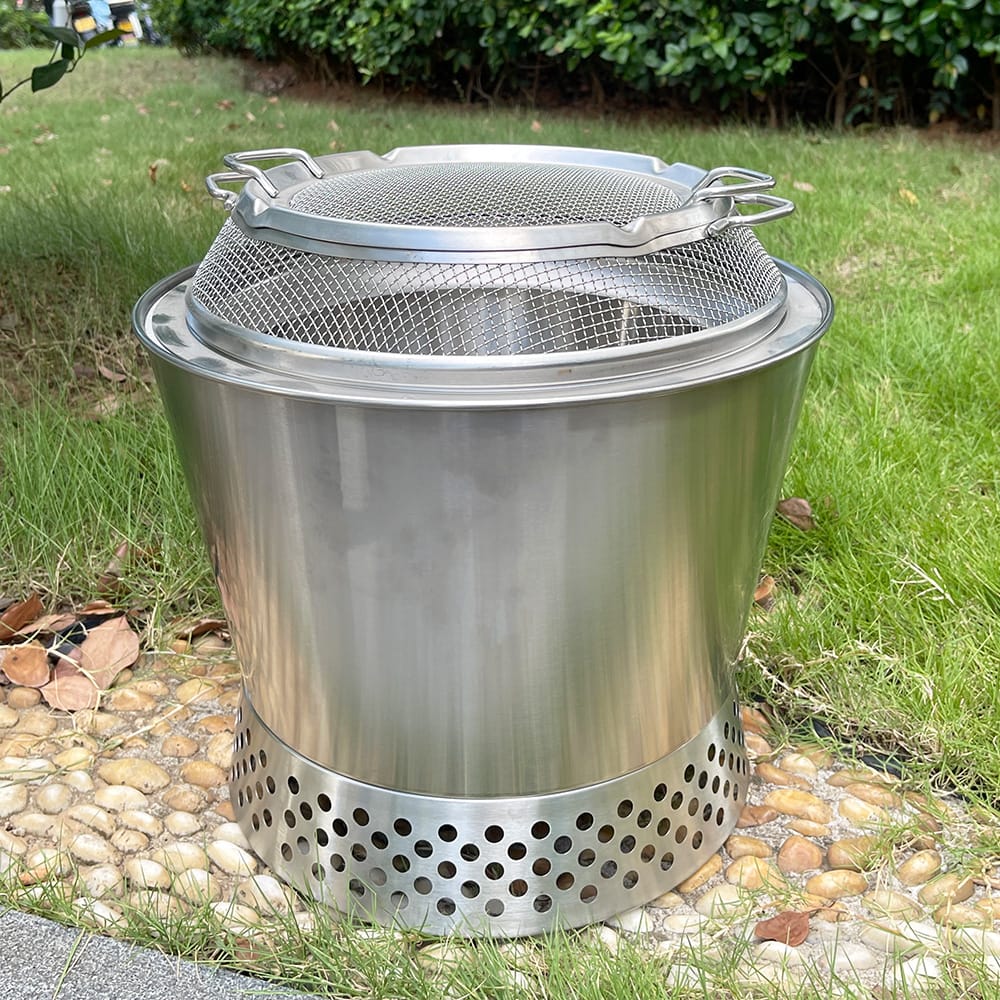
The practical constraint was entry cost. With most suppliers in this category requiring 50 to 200 units minimum, initial market validation was capital-intensive before a single unit had sold. We started at 10 units of the KZ-YS500, a 19.5-inch double-wall smokeless fire pit in an open bowl form that is visually distinct from the cylindrical geometry defining the category’s most recognized products. The two-piece split body design means the combustion chamber lifts off completely, leaving the ash bowl exposed and emptied in seconds without moving the unit or waiting for full cooling. In any context involving repeated use (hospitality, events, or rental operations), this is the difference between a manageable maintenance routine and a friction point that discourages use.
The configuration used the full customization range available at that MOQ: powder-coated exterior matched to the client’s property color palette, laser-engraved logo on the outer wall, custom-designed color box packaging, and a curated accessories bundle of fire poker, carry bag, and grill rack matched to the use context. The result was a product that existed nowhere else under anyone else’s name. That is the only durable answer to the price comparison problem that defines commodity distribution.
Second order: 30 units, placed before the first batch had cleared. No returns.
How to Verify a Double Wall Fire Pit Before Any Bulk Commitment
The sample stage is the only point in the sourcing process where quality problems can be identified at low cost. The following five steps apply regardless of which sourcing channel you use. For open market sourcing, they are non-negotiable prerequisites to bulk commitment. For buyers working with a specialized sourcing partner, they are the verification layer that confirms the partner’s quality claims before volume is scaled.
Step 1: Request a mill test certificate for the 304 stainless steel fire pit specification
The correct document is a Mill Test Certificate issued by the upstream steel coil supplier, not a product certificate issued by the factory itself. The factory certificate describes the product. The Mill Test Certificate records the actual batch chemical composition.
For true 304 grade stainless steel: expect approximately 18% chromium and 8 to 10% nickel. A 201-grade substitution shows nickel content below 3.5%, with elevated manganese compensating for the reduced nickel. This distinction matters because 201 and 304 are visually indistinguishable in brushed finish. Critically, the cold-working and stamping processes used to form double-wall fire pit bodies can modify the magnetic properties of both grades. A finished, formed fire pit component from either material may produce similar magnetic responses depending on forming depth and work hardening. A magnet test on a finished fire pit is therefore not a reliable primary verification method. The Mill Test Certificate is.
Step 2: Physically measure the air gap between inner and outer walls
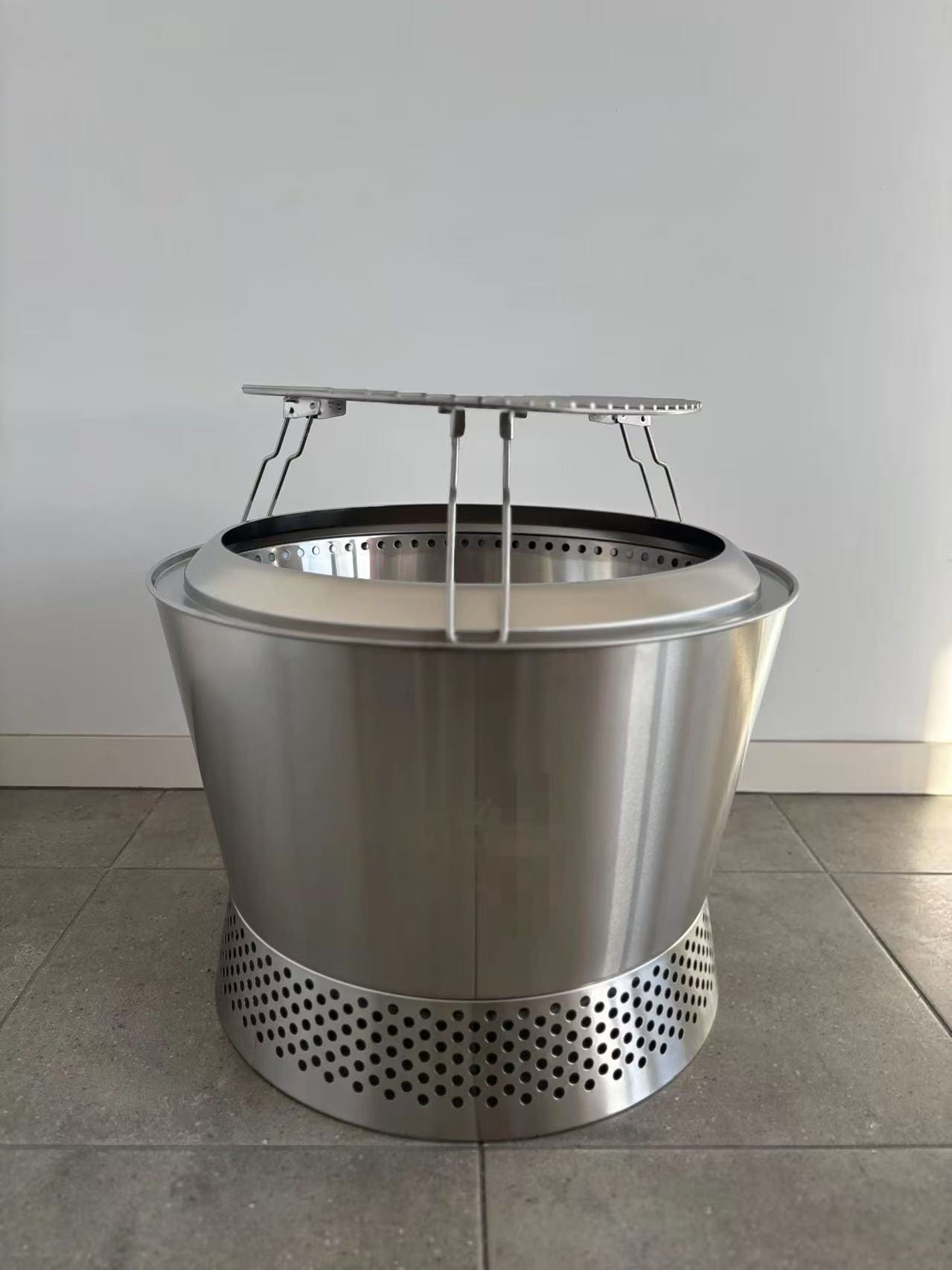
The double wall fire pit air gap should be continuous and measurable on any fire pit 19 inches or larger. Confirm this by visual inspection or feeler gauge along the full gap perimeter. The gap should be uniform in width; visible inconsistency indicates tooling drift or forming irregularity in the inner wall. Some suppliers produce single-wall products with punched outer-wall holes and describe them as double-wall construction. Physical measurement eliminates ambiguity.
Step 3: Count and inspect the secondary burn holes at the top rim
Hole count, distribution uniformity, and diameter consistency are externally observable indicators of stamping die condition and process control quality. Count the holes on the sample. Check that distribution is even around the full circumference. Confirm that hole diameter is consistent rather than variable. Uneven distribution or inconsistent diameter indicates worn tooling or insufficient quality control in the stamping process, both of which predict variable performance across units within a production batch.
Step 4: Request a smoke test video using split hardwood, not pellets
Pellet fuel produces a lower-moisture, more consistent burn than split hardwood and is easier to use to pass a smoke test. Request a burn test video using split hardwood under real-use conditions. The secondary flame ring at the rim should be visible and continuous once the fire reaches operating temperature, typically 10 to 15 minutes into the burn. If visible smoke continues building after the fire is established with no secondary flame ring appearing, the secondary combustion system is not functioning regardless of how the product is described.
Step 5: Confirm ash management design and replacement parts availability
A removable ash pan and the availability of replacement components (inner grate, bottom screen) are indicators of long-term product serviceability. The fire pit ash pan question appears constantly in end-customer reviews. It is almost never raised by wholesale buyers at the sample stage, which is the only point where a supplier commitment on replacement parts can be negotiated into the supply agreement. These factors directly affect end-customer satisfaction and repeat purchase behavior, which in turn affect your brand’s reputation in the channel.
Quality framework: Each of these checks maps directly to our AQL 2.5 inspection protocol and its product-specific defect classification table. Under AQL 2.5, defects are divided into three tiers: Critical (zero tolerance, immediate batch rejection), Major (the threshold against which batch acceptance is evaluated), and Minor (surface cosmetic issues that do not affect function or safety). Steel grade documentation failure, air gap inconsistency, and secondary burn hole distribution outside specification are all classified as Major defects under our table. This framework ensures every production batch is evaluated against defined acceptance criteria before shipment, not after arrival.
The Margin Model: Putting the Fifth Criterion Into Practice
Smokeless fire pit wholesale sourcing works backward from retail, not forward from a supplier’s quoted price. The US retail market provides the price anchors. Your margin requirement provides the ceiling. The difference between those two numbers is your negotiating boundary going into any supplier conversation.
US retail price structure, public price records March 2026:
| Retail Price Range | Product Characteristics | Reference Products |
|---|---|---|
| Under $100 | Single-wall or poor-quality imitation double-wall, unbranded | Unbranded Amazon listings |
| $100–$200 | True double-wall, 430 steel or carbon steel, basic accessories | Entry-level OEM products |
| $200–$280 | True double-wall, 304 steel, partial brand positioning | BALI OUTDOORS 27″ at $229–$270 |
| $249–$330 | Solo Stove Bonfire: Amazon $249.99, Home Depot $329.99 | Brand premium tier |
| $395–$600 | Heavy gauge steel, Made in USA, integrated cooking systems | TIKI $295–$395; Breeo $479–$600 |
Margin model working backward from a $249 retail target:
The $200 to $280 range is where a differentiated wholesale product competes most effectively: below Solo Stove’s advertised price, above the commodity tier, with enough room to signal genuine quality to a buyer already familiar with what this category should deliver.
- Target retail price: $249
- Target gross margin at 40%: retain $99.60
- Maximum total landed cost (product cost plus international freight, import duties, and certification cost allocation): approximately $149
That $149 figure is the ceiling to bring into supplier negotiations before the first quote is received, not a target to negotiate toward after receiving one.
OEM customization and retail price uplift:
- Brand laser engraving: potential retail price increase of $20 to $40 on the same base product
- Exclusive colorway: removes the product from direct Amazon price comparison searches
- Accessories bundle (fire poker, rain cover, carry bag): composite retail price increase of $25 to $50
- Custom packaging design: unlocks gift positioning and retail shelf premium at price points unavailable to standard product
Differentiation does not transfer cost to the buyer. It makes the product incomparable at the price point where direct comparison would otherwise determine the outcome.
Frequently Asked Questions
Q1: What is a good wholesale alternative to Solo Stove for retailers?
The answer is not a specific brand. It is a sourcing arrangement that satisfies three conditions: the supplier supports product customization sufficient to create a differentiated retail position, quality is documented through verifiable third-party inspection, and the supplier carries accountability for batch quality rather than transferring that risk to the buyer. Among solo stove alternatives wholesale candidates, those three conditions are reliably found in the specialized sourcing partner channel, not in open market platforms or US brand dealer programs where the terms of engagement constrain your margin and brand-building options.
Q2: Can I put my own brand on a smokeless fire pit ordered wholesale?
Yes, but capability varies significantly by supplier type. Specialized B2B exporters typically support laser engraving, custom colorways, private label packaging, and accessories configuration. Factory-direct suppliers technically offer customization but often require higher minimum quantities to activate those options and have limited product definition capability beyond applying a logo. Confirm actual execution capability during the sample stage, not at the initial quotation.
Q3: What certifications do I need to sell smokeless fire pits wholesale in the US?
No mandatory certification currently exists for consumer-grade wood-burning fire pits in the US market. For buyers targeting large retail buyers or corporate procurement channels, an EN 1860 test report or SGS inspection certificate provides meaningful negotiating support. Buyers planning European distribution require CE certification and EN 1860-1:2024 compliance. Certification terms should be negotiated into the supply agreement before the first sample order, not requested after production is complete.
Q4: What is the typical MOQ for wholesale smokeless fire pits?
Most suppliers in this category set minimum order quantities between 50 and 200 units. Low-MOQ factory-direct orders, typically below 50 units, often involve standard product without customization support and reduced quality control consistency. Working with a specialized sourcing partner can bring the entry threshold to 10 to 20 units for initial market validation, a meaningful reduction in capital commitment at the stage where product-market fit is still being confirmed.
Q5: How do I verify that a supplier’s stainless steel is actually 304 grade?
Request the Mill Test Certificate from the upstream steel coil supplier. For 304 grade, expect approximately 18% chromium and 8 to 10% nickel. A magnet test on finished fire pit components is not a reliable verification method because cold-working and stamping processes can modify the magnetic properties of both 201 and 304 steel, producing ambiguous results on formed parts. For bulk orders, commission a third-party inspection report from SGS, Bureau Veritas, or QIMA before shipment.
Q6: How much margin can I realistically make on smokeless fire pit wholesale sourcing?
In the $200 to $280 retail range, gross margins of 35% to 45% are achievable under standard sourcing conditions. The variable that most affects realized margin is not the per-unit wholesale price but the degree of product differentiation: a private-labeled, custom-packaged product in an exclusive colorway commands pricing that commodity wholesale sourcing cannot access. The margin model in the previous section provides specific working numbers for a $249 retail price target.
Q7: What is the difference between a real double wall fire pit and a single-wall imitation?
A correctly engineered product in this category has a continuous air channel between the inner and outer walls, intake vents at the base of that channel, and secondary burn holes at the rim directed inward into the flame zone. A single-wall product with punched holes in the outer wall may appear identical in photographs but lacks the preheated air delivery system that secondary combustion requires. Physical verification (measuring the air gap with a feeler gauge and confirming that the rim holes exit from the air channel rather than the outer wall surface) is the only reliable check. Specification sheets and product photography are insufficient.
Work With a Supplier Who Builds Margin, Not Just Products
OneProStove is a Ningbo-based B2B smokeless fire pit exporter working directly with production facilities across the Yongkang and Jiangbei manufacturing clusters. All production runs are inspected under an AQL 2.5 protocol with a product-specific defect classification table. Third-party pre-shipment inspection is supported through SGS, Bureau Veritas, or QIMA on all wholesale orders. Mill Test Certificates for 304 stainless steel specification are provided as standard documentation. Operations run under ISO 9001 quality management standards.
MOQ starts at 10 units. OEM support includes laser engraving, powder coat color customization, private label packaging, and accessories configuration. CE, ROHS, and ASTM compliance documentation is available for target-market-specific requirements.
If you are evaluating wholesale sourcing options and want to request a sample quote, the OneProStove team responds to all B2B inquiries within 24 hours on business days.
FAQ
What is a good Solo Stove alternative for wholesale buyers?
A manufacturing partner producing the same double-wall, secondary-combustion construction on wholesale terms — with material certificates, inspection access and low minimum orders. Our sourcing criteria are covered in the article above.
Can Solo Stove-style fire pits be produced at low MOQ?
On standard double-wall platforms, yes: branding-level customization — laser logo, manuals, colors — runs at 10 units per model, with the design work free of charge.
What should I compare between Solo Stove and an alternative?
The engineering (air gap proportion, injection vent position), material grade documentation, inspection terms, and whether the supplier will provide burning videos and drop-test recordings — not only the unit price.
Next Step: Source from OneProStove
Ready to compare suppliers for your next order? see the KZ-YS conical fire pit series or explore our wholesale program — MOQ 10 units per model, 7-day sampling, 15–45 day lead time, OEM/ODM support. Questions? Contact us.
Related reading: Smokeless Fire Pit Sourcing: The Complete B2B Technical Guide