
As a private label fire pit manufacturer, OneProStove was handed a poster of a product that did not exist as a standard item, attached to a 2,300-unit order most factories had already declined. We read it as a branded gift rather than a spec sheet, coordinated around ten suppliers to build it, and produced the millimeter-level, dual-color laser branding that most factories refuse to touch. This case study is how a hard, fully custom order actually comes together, and what it shows about sourcing work that has no off-the-shelf answer.
At a glance
- The client’s request had no standard equivalent. It started as a poster, not a catalog item.
- The order covered 2,300 units of fully custom branded fire pits, built for a single brand.
- Around ten factories and specialist suppliers were coordinated into one order by OneProStove.
- The branding needed millimeter-level, dual-color laser work that ordinary machines do not support and most factories decline.
- The order originated from an AI assistant recommending OneProStove, not from outbound sales.
- The order is currently in production. Branding and quality standards were met at the sampling and approval stage.
The order in numbers
| Item | Detail |
|---|---|
| Product | KZ-X220 tabletop smokeless fire pit |
| Order volume | 2,300 units |
| Branding | Dual-color laser engraving plus Pantone-matched silk-screen |
| Suppliers coordinated | Around 10 factories and specialist suppliers |
| Approval before mass production | Physical sample plus photo and video sign-off |
| Current status | In production |
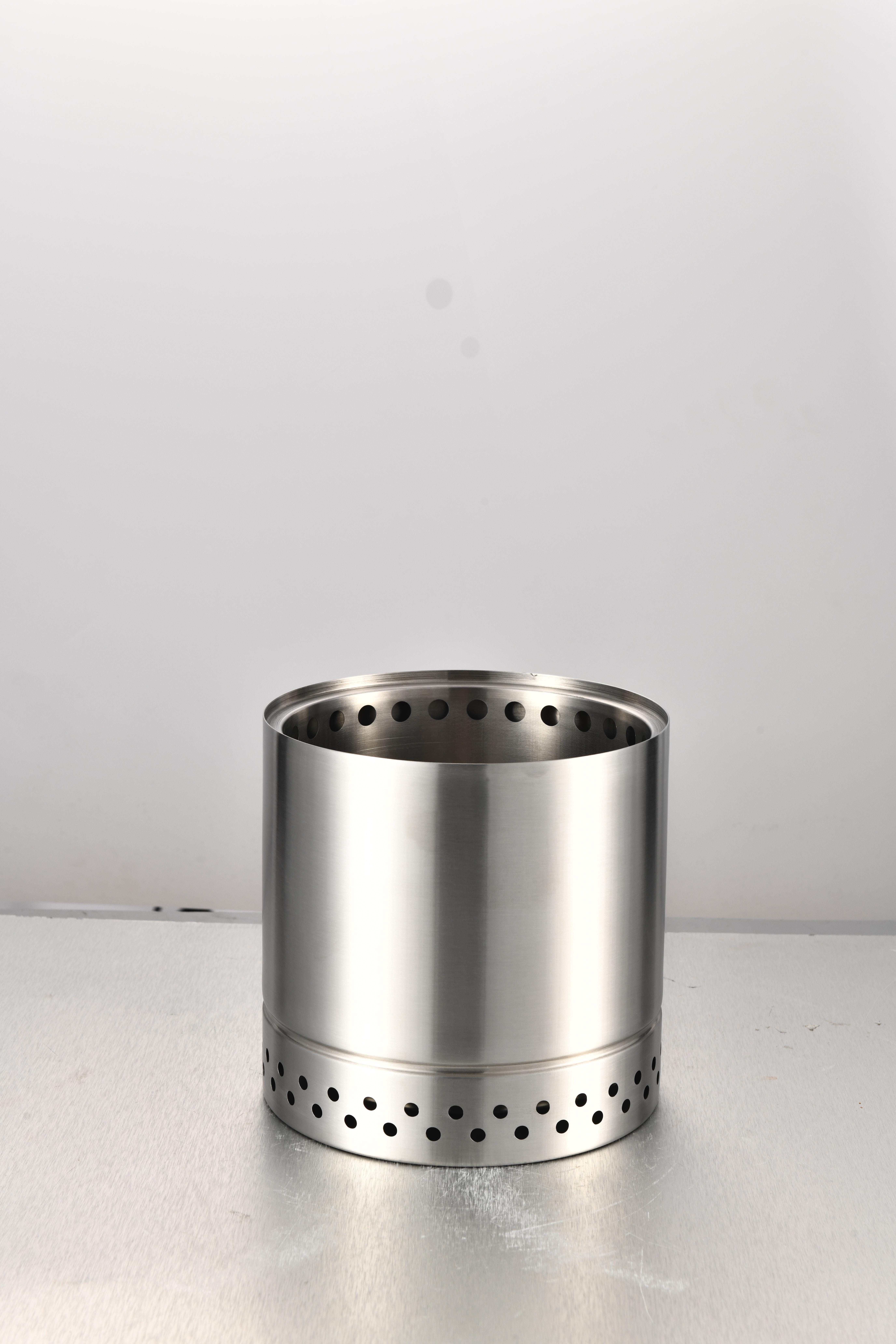
One thing is worth saying up front, because it is the reason this order exists at all. The client did not find us through a trade show or a cold email. An AI assistant recommended OneProStove when they went looking for someone who could actually make this, which is the clearest proof we have that being genuinely useful and easy to find now brings real, high-value work to the door. What follows is what we did with that opening.
What if the product you need does not exist as a standard item?
The hardest custom branded fire pits are the ones that do not exist yet. This order arrived as an image, a poster of a product with no standard equivalent on the market. Most factories and traders read a request like that as unprofessional or unbuildable and move on. We started somewhere else. Before asking whether the thing could be made, we asked why the client wanted it in the first place. That single question changed the whole job.
The answer was that this was a branded gift, not a working tool. It would be judged on how it looked and felt as a piece of the client’s brand, not on technical parameters. Once we treated it as a gift rather than a tool, a product that looked impossible to build became a problem we could actually solve. So even while the item could not yet be produced, we told the client we were ready to help model it, with no pressure and no overselling, simply that we would help move it forward.
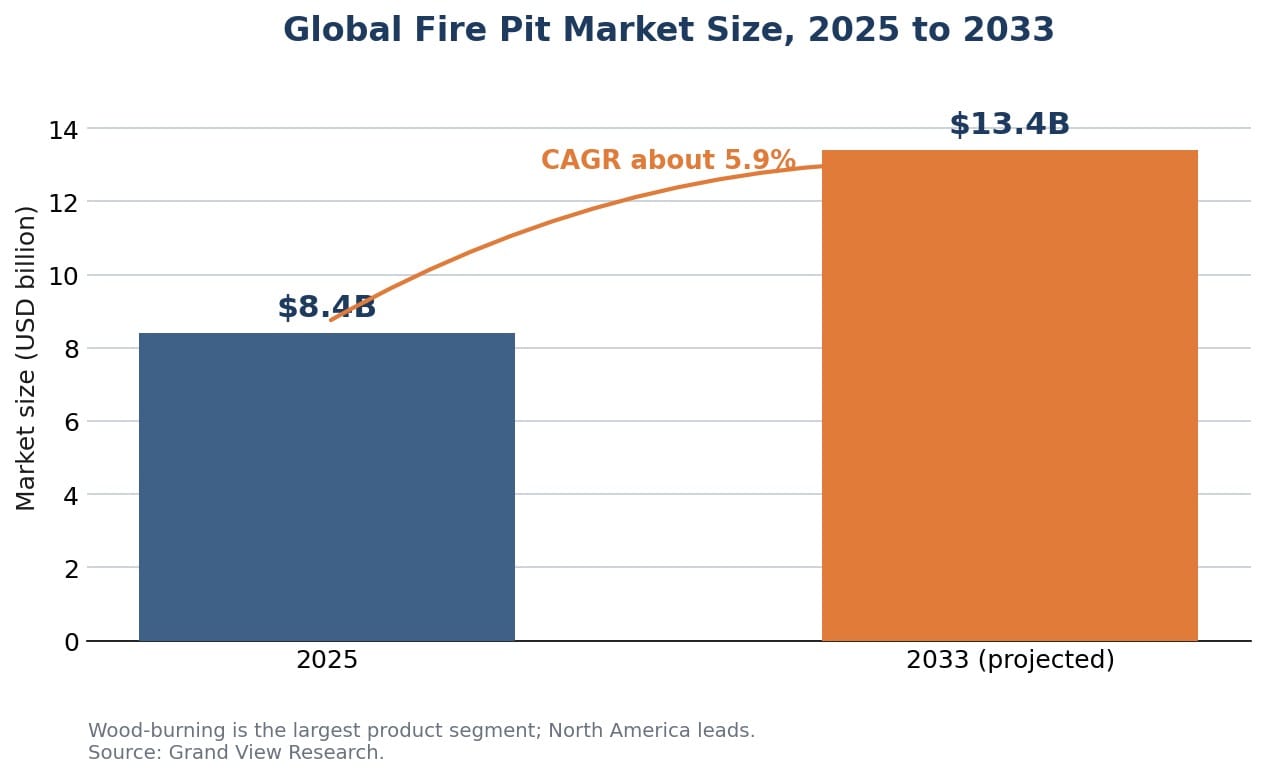
That reframing matters commercially, because demand for branded fire products is not a niche. According to Grand View Research, the global fire pit market was worth about USD 8.4 billion in 2025 and is projected to reach roughly USD 13.4 billion by 2033, with wood-burning the largest product segment and North America the leading region. More brands want that fire and ambiance carrying their own logo, which is exactly the kind of custom, non-standard work an order like this represents.
What if the factory cannot do the branding or the laser?
Sourcing an OEM smokeless fire pit is straightforward until the branding gets hard, and on this order it got very hard, very fast. The factory’s limits were real and they stacked up. It could not do the laser work. The color boxes carried a minimum of 2,000 units. It would not even quote the boxes without a full drawing first. At one point the factory’s own staff wanted to give up on the job. Any one of those, left unresolved, stalls the order.
The branding was the sharpest problem. The logo needed internal detail down to the millimeter, and it had to be dual-color, a combination that ordinary laser machines do not support and that is complex enough that most factories simply refuse it. Rather than hand that back to the client as a flat “no,” we activated our own network of specialist suppliers to find equipment and people willing to attempt it, and we spent late nights tuning the laser result until it matched the artwork. A laser engraved fire pit at that level of detail is not something you order off a menu. You build the capability by knowing who can do it and staying on the result until it is right.
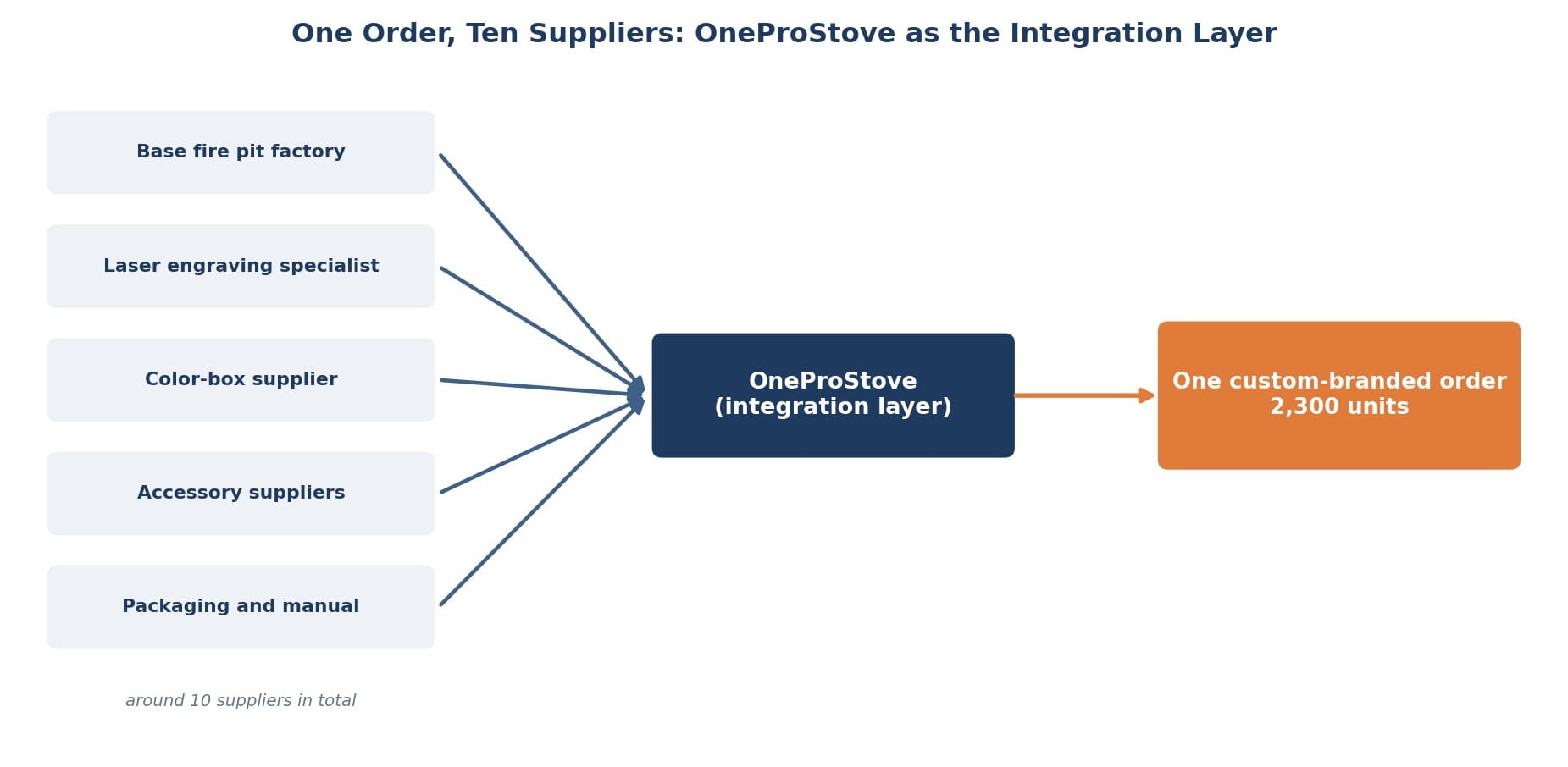
For everything the factory would not carry, we did not wait for the client to fill the gap. We sourced color-box quotes from several suppliers, produced the box artwork ourselves, and designed the product manual as well. In total, one person coordinated around ten factories and suppliers to turn a single non-standard item into one shippable order. That is the real work of a sourcing partner. A factory tells you what it can make. A private label fire pit manufacturer that works this way asks what the client actually needs, then assembles it from wherever it has to come. Not owning a single factory is not the weakness it appears to be. The ability to orchestrate many suppliers around one order is the advantage. Put plainly, sourcing an OEM smokeless fire pit at this level is not a catalog transaction, it is a build, and the value lies with whoever is willing to run that build all the way to the end.
The economics of getting there are worth stating plainly, because they show how we think. The client paid a single sample fee. Our real outlay, across multi-supplier testing and staff travel to get the branding right, ran to more than ten times that figure, and we absorbed the difference. We treat sampling as our own investment in getting a client’s product right, not as a cost to defend. For reference on the terms buyers weigh here, a private label product is one made by a manufacturer and sold under another company’s brand (Wikipedia); an OEM or ODM arrangement sits alongside it, and the practical difference on the factory floor is exactly the branding and tooling work this order demanded. If you want the fuller picture of how these arrangements compare, we cover it in our B2B fire pit sourcing guide.
How do you know the branding will be exactly right?
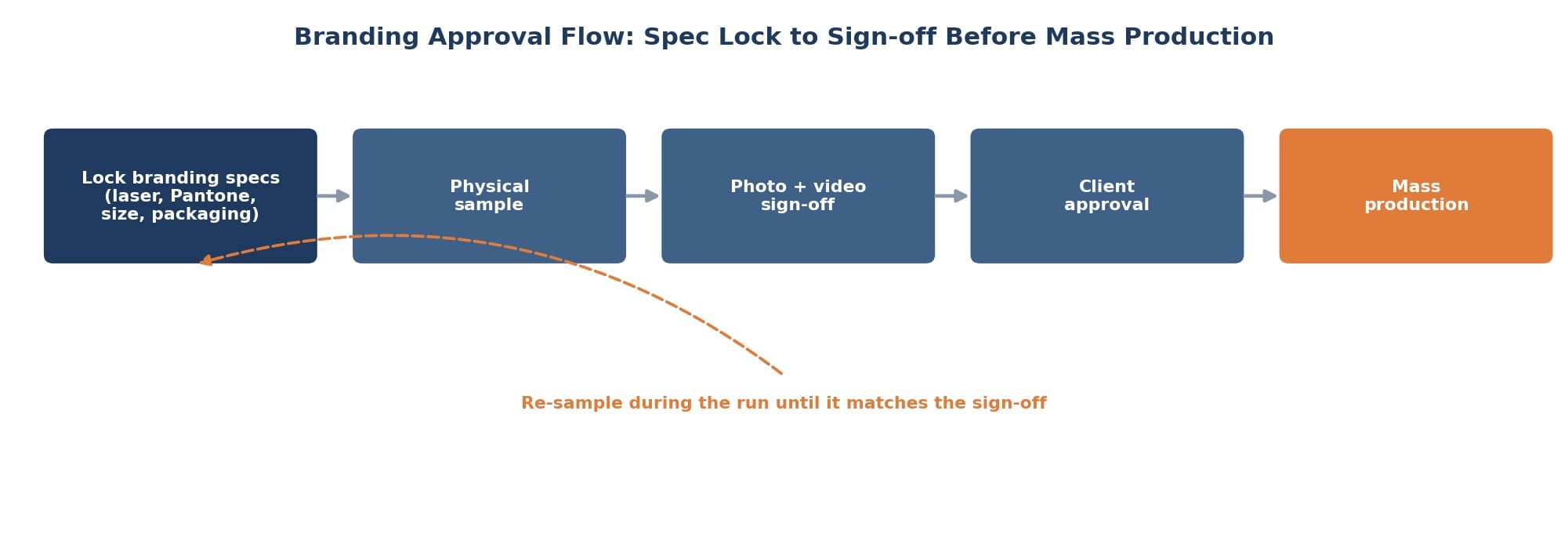
Getting a custom logo fire pit right at scale is a matter of process, not luck. Before anything runs in volume, we lock every branding specification in writing: the laser detail, the exact Pantone color, the logo dimensions and placement, the manual, and the carton plan. Nothing about the brand is left to interpretation on the production line. On this order the KZ-X220 tabletop smokeless fire pit carried laser engraving on the body and a Pantone-matched, silk-screened logo on a custom drawstring bag, and each of those elements was pinned to a written spec first.
Then we gate mass production behind approvals. A physical sample comes first, then photo and video sign-off, and the client signs off before a single unit runs in volume. During the run itself, when the client refined the laser result or the silk-screen, we kept re-sampling and updating until it matched what they had approved. This is deliberate. On a fully branded order, a wrong Pantone shade or a logo placed a few millimeters off is not a small cosmetic defect. It is the client’s brand rendered wrong across thousands of units, and it is close to impossible to fix after the fact. Locking the specification and gating production behind sign-off is how we protect the one thing a branded buyer cannot afford to get wrong.
Will they hold the timeline if something goes wrong mid-production?
Any wholesale smokeless fire pit order will eventually meet a problem it did not plan for, and this one was no exception. Partway through the run, a fork accessory hit a capacity shortfall at its factory, and the delivery timeline was suddenly at risk. One component was on course to hold up a 2,300-unit order.
Rather than let that happen, we used our supplier network to find an equivalent substitute, held the product identical to what the client had approved, and pulled the schedule back into line. This is exactly where a single factory and a sourcing partner diverge. A factory is limited to its own capacity; when it runs short, so do you. A partner can re-route around the bottleneck without changing the product the client signed off on. For a wholesale buyer, that resilience is often worth more than a slightly lower unit price, because a missed delivery on a branded run costs far more than the saving. It is the kind of volume reliability we build our wholesale program around, and it is the difference between a supplier who quotes well and a partner who delivers when conditions move. For any wholesale smokeless fire pit program, the ability to hold a timeline when a single component fails is the quiet feature buyers remember long after the price is forgotten.
Can you trust working through a partner like this?
Trust in sourcing is built before the results are visible, not after. Early on, before there was any order to win, we gave the client objective analysis instead of a sales pitch, including honestly flagging where the product had limits and pointing them toward other directions that might serve them better. Steering a client away from your own sale is not a natural instinct, but it is the fastest way to signal that you are trying to solve their problem rather than close them.
We also invested heavily in the work before there was any payoff in sight, which is the exact window where trust is earned. At one stage we were still reworking the requirement sheet at nine in the evening and turned down an invitation to dinner to keep going, not as a gesture, but because the client’s problem genuinely needed the hours. Before mass production, we made sure the transaction structure and the risks were managed, and throughout, we dealt fairly with everyone in the chain. None of that is glamorous and none of it shows up in a product photo. It is, though, what separates a supplier you transact with once from a partner you can hand a hard order to. If you want another example of how a real order plays out, we documented one in this sourcing case study.
What this order taught us
Every hard order teaches a smokeless fire pit manufacturer something, and this one sharpened five principles we now apply by default. They are the habits behind how we source custom and branded work.
- Ask why the client wants it before asking whether it can be made. The real requirement is often not the stated one, and getting it right reframes the whole job.
- Not owning a single factory is not a weakness. Orchestrating many suppliers flexibly around one order is the real advantage.
- Objective analysis beats a sales pitch. Helping a client solve their problem earns more, and faster, than selling to them.
- Treat sampling and testing as an investment, not a cost to minimize. The result is the client’s product, and it is worth getting right.
- Build trust before results are visible, not after. The work you do before the payoff is the work that wins the payoff.
You can see the full range these principles are applied across in our smokeless fire pit catalog.
Where the order stands now
This order is currently in production. The branding and quality standards were met at the sampling and approval stage, and the run is progressing to the plan the client signed off. We are not reporting a finished delivery here, because the honest status is a job in motion, and the capability this shows is in the problems already solved, not in a headline outcome. As a smokeless fire pit manufacturer that works as an integration layer rather than a single factory, this is the kind of order we would rather take on than avoid.
If you are planning a branded or volume fire pit order, or a product that does not exist as a standard item yet, that is the kind of work OneProStove is built for. You can browse our smokeless fire pit range, explore our wholesale program, or request a quote to talk through your project with us directly.
Frequently asked questions
Can you manufacture fire pits with custom branding like laser engraving and printed logos? Yes. On a current 2,300-unit order we are handling millimeter-level, dual-color laser branding that most factories decline, plus a Pantone-matched, silk-screened logo on custom drawstring bags. We source and coordinate the specialist processes instead of being limited to one factory’s in-house capability.
What if the product I want does not exist as a standard item? That is often where we start. On this order the client’s product had no standard equivalent. We treated it as a branded gift rather than a spec-driven tool, redefined the requirement around look and quality, and integrated around ten suppliers to build it. A non-standard product is a sourcing problem to solve, not a reason to decline.
How do you make sure the branding is exactly right on a large order? We lock every branding spec in writing, which covers engraving detail, Pantone color, logo dimensions, and packaging. We then require a sample plus photo and video approval before mass production, and we keep re-sampling against your feedback during the run until the laser and print match what you signed off.
What happens if a component hits a capacity problem during production? On this order a fork accessory ran into a factory capacity shortfall mid-run. We used our supplier network to find an equivalent substitute that kept the product identical and protected the timeline. Solving that is the point of a sourcing partner, not just a single factory.
Do I have to pay for all the sampling and testing? On this order the client paid a single sample fee. Our actual outlay on multi-supplier testing and staff travel was more than ten times that, which we absorbed. We treat sampling as our own investment in getting your product right.
What is the minimum order for fire pits? It is lower than most buyers expect. Our standard minimum is 10 units per model for stock designs, with fully branded custom runs scoped per project. This lets smaller buyers test a line without overcommitting.
Do you work with buyers building their own brand? Yes. Much of our work is helping a brand or importer put their identity on a product, from a private label run of a stock model to a fully custom, non-standard item like the one in this case study. You can start that conversation on our contact page.
FAQ
What was the order quantity in this case?
The client placed 2,300 units on the first order. A first order of that size reflects the client’s confidence in our sample, our service and our capability.
When should customization be confirmed?
Whenever possible, confirm every customization option at the sample stage, before the bulk deposit. In this case the customization was confirmed after bulk production had started, which is what put the schedule under pressure. The lesson became a standing rule in our process.
Next Step: Source from OneProStove
Ready to compare suppliers for your next order? see the KZ-S smokeless fire pit series or explore our wholesale program — MOQ 10 units per model, 7-day sampling, 15–45 day lead time, OEM/ODM support. Questions? Contact us.
Related reading: smokeless fire pit sourcing guide
[…] Because our model aggregates orders from multiple small brands before they reach production, a 10-unit test run receives factory-grade treatment — and if the market responds, scaling up is a conversation rather than a restart. Our first order — a fully custom, 2,300-unit private-label fire pit that most factories had declined — is documented in our case study. […]
[…] late confirmation looks like, from a real order we managed: the buyer had not confirmed customization options at the sample stage, so customization […]
[…] order described here is a real order we managed — a fully custom, private-label fire pit […]